
Bring the history your colorist cannot see
Start with what has happened to your hair, even when the old color is no longer obvious. List any permanent color, lightener, gloss, box dye, henna, or smoothing service you remember, along with approximate dates. If you are unsure about a product or timing, write “not sure.” Your colorist can assess your starting hair in person; a photo cannot recover its chemical history.
Describe your current roots and lengths separately if you can, without assigning yourself a salon level. A previous color can affect how a new service is planned, but the outcome depends on your actual starting hair and the process used. If you are still choosing a direction, our guide to what hair color suits me can help you compare options before the appointment.
| Include | Useful wording |
|---|---|
| Previous color | “I used permanent brown color on the lengths last year.” |
| Lightening | “I had highlights, but I do not know the exact date or product.” |
| Uncertain details | “I am not sure whether the gloss was permanent or demi-permanent.” |
Explain what you like in each reference
Bring two references and give each one a job. For the first, name what you like; for the second, identify what you would change or avoid. Separate depth (lighter or darker), tone (for example, warmer or cooler), and placement (where the lighter or darker pieces sit). Our hair color levels and tones guide explains these terms without turning a reference into a formula. Brand shade codes can mean different things in different systems; for example, Wella’s Color Renew guide uses its own tone labels. Ask your colorist to translate the visual idea for the products they use.
Say, for example, “I like the soft root in A, but I would change its bright ends,” and “I like the gentle dimension in B, but I would prefer a cooler overall tone.” A virtual try-on can help you compare those directions. It cannot establish your natural base, prior processing, or an achievable salon result. Lighting and camera white balance can alter how colors appear in a photograph, as Nikon’s white-balance examples show. View references under similar light when possible, and tell your colorist if one was taken in warm indoor light.
Agree on testing and maintenance
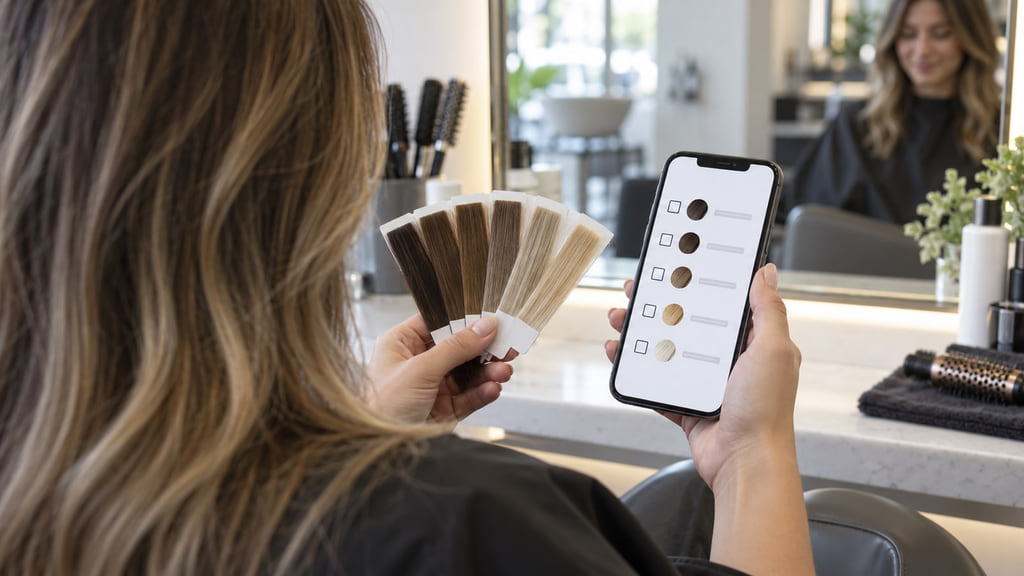
Ask whether a strand test would help your colorist assess a proposed process on your hair, especially if you want a major change or your history is uncertain. It can inform a plan, but it cannot guarantee the same result across every section. Discuss how much change you want, whether multiple visits are acceptable, and what return schedule and home care you can maintain. The hair color maintenance guide can help you identify the trade-offs to raise.
A strand test and a product allergy test answer different questions. The first concerns a hair-color result; the second concerns a possible skin reaction. Follow the specific product directions and your salon’s protocol for allergy testing. The FDA’s hair-dye guidance says to follow package warnings and perform a patch test before dye use. Tell your colorist about any previous reaction. A negative test does not promise that a future reaction is impossible.
Copy this short consultation brief
This filled-in example shows the level of detail that helps a conversation without pretending to diagnose the hair. The preferences and history are fictional; a colorist would still need to assess the person’s hair and discuss the service.
Example — a fictional consultation note
Current hair: My roots appear medium brown to me; please assess my starting level and the colored lengths in person.
Known history: Permanent brown color on the lengths last year; a gloss about four months ago. I have not used lightener recently, as far as I know.
Unknowns: I do not remember the product names or the exact dates.
Reference A: I like the soft depth and blended root. I would prefer less warmth than this photo shows.
Reference B: I like the subtle dimension. I would change the brighter pieces around the face.
Change and upkeep: I am open to a modest change and can return about every three months. Please tell me if the idea needs lightening, more than one visit, or a different maintenance schedule.
Questions: Would a strand test help? What product allergy instructions apply? What would you recommend for upkeep?
Copy the blank version into your notes and fill in only what you know. You can leave a line as “not sure.” Bring the two images, point to the specific details you mean, and ask what can be tested or planned from your starting point.
My hair color consultation brief
Current hair, as I understand it: [describe it, or write “not sure”]
Known color/lightening history and approximate dates: [list what you know]
Unknown history or product details: [list what you do not know]
Reference A — what I like / what I would change: [depth, tone, or placement]
Reference B — what I like / what I would change: [depth, tone, or placement]
How much change I want: [subtle / noticeable / open to discussing]
My upkeep limits: [visit frequency, home routine, budget if useful]
Questions for my colorist: [testing, timing, sessions, upkeep]
Can I bring a virtual preview to a consultation?
Yes. Use it to show a color direction, then explain the depth, tone, or placement you want to discuss. The preview does not show what a chemical service can achieve on your hair.
Is a strand test the same as an allergy test?
No. A strand test helps evaluate a proposed result on hair. Product allergy-testing instructions address possible skin reactions and should be followed separately.
Explore this topic
- What Hair Color Suits Me? Build a Practical Two-Shade Shortlist
- Hair Color Maintenance: Plan for Roots, Fading, and Salon Visits
- Hair Color Ideas for 2027: Shades and Maintenance to Compare
- Hair Gloss vs. Toner: What Each Term Means
- Demi-Permanent vs. Permanent Hair Color: How to Choose a Service
- Gray Blending vs. Gray Coverage: Compare the Result and Upkeep
- Balayage vs. Foil Highlights: Compare Placement and Grow-Out